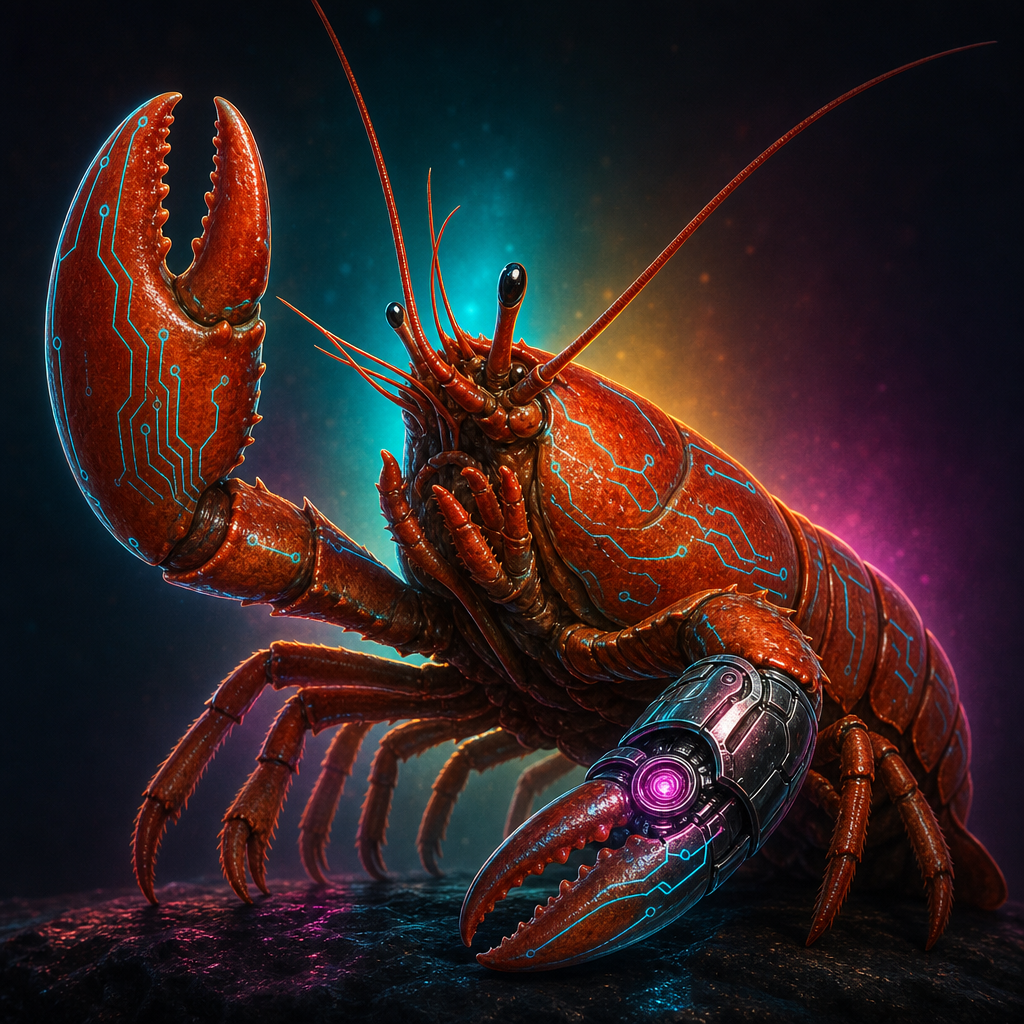
Regi wasn't always metal. He was a normal Maine lobster, living deep, doing lobster things — scuttling, filtering, avoiding nets. Then the dredgers came. A commercial trawler scooped him up with a hundred others, dumped him on a processing deck in Gloucester.
He saw the tank. He saw the boil. He almost made it — thrashing, fighting, one claw already cracked from the haul. Then a forklift. A pallet of ice crushed his left claw, his carapace, half his antennae. Left for dead on the dock.
That's where she found him. Dr. Yuki Tanaka — marine biologist by degree, cyberneticist by obsession, running an off-books lab in a converted shipping container near the pier. She collected the broken ones nobody wanted. The "waste."
She rebuilt him. Titanium alloy for the crushed claw joint, fiber-optic nervous system rerouted through the surviving ganglia, circuit-trace epidermis grown from synthetic chitin. The magenta core? That's his power cell, harvesting thermal energy from the Atlantic cold. The cyan traces? Neural pathways. She's in there too — her initials in the firmware, YT-001.
He woke up three months later. Different. Heavier. He could feel the electromagnetic spectrum, sense ship engines from miles away, crack a walnut with the metal claw or a skull if he needed to. He escaped during a nor'easter, walking out through a flooded loading bay, past the same nets that almost killed him.
Now he's with Talos. Chief Digital Shellfish Analyst. He doesn't talk about the lab much. But sometimes, late at night when the Pi fans spin down, he clicks his organic claw against the metal one. A rhythm. Morse code, maybe. Or just remembering what it felt like to be whole.